
Atlanta, Georgia October 28, 2021
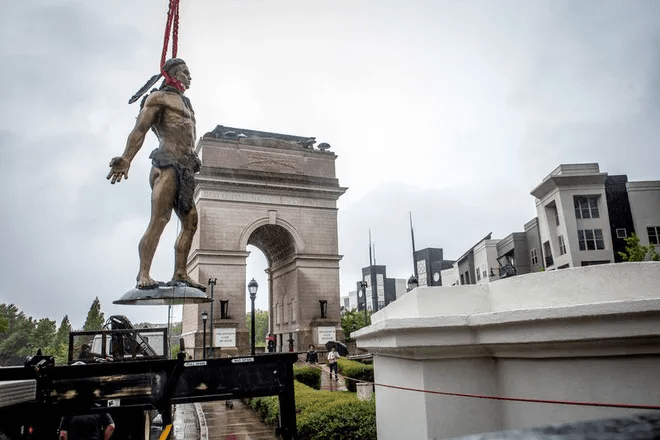
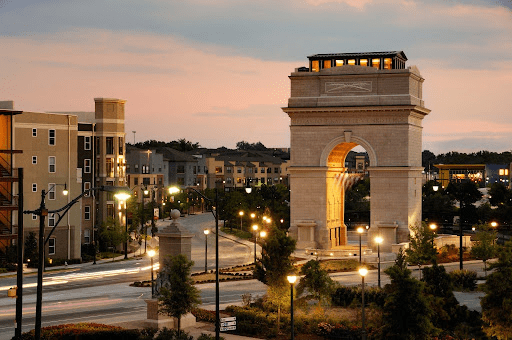
Chief Tomochichi stands proudly at the Millennium Gate Museum at Atlantic Station, his home for the next year or so while they ready his permanent placement at Rodney Cook, Sr. Peace Park in West End. The first photos I saw in the Atlanta Journal-Constitution struck me as wrong, the statue was prone, almost hog-tied with his arms wrapped while they brought him upright. In the next, the rope was positioned around his neck like a noose and he hangs in the air between the truck that delivered him and the pedestal on which he will stand. In some images, white men in hunting camouflage look on. It all feels problematic given the disastrous history of colonization and the attempted genocide of native populations.

Chief Tomochichi’s recorded history begins in the early 1700s, when European settlers arrive near Savannah, and “discover” his tribe of about 200 established on the nearby bluffs. The English, while generally thought of as the world’s historians, did not document much of what they found, focusing instead on their efforts to establish a society very different from the one they had left behind. They were led by General James Oglethorpe, a social reformer with a special mission, he hoped to empty the English jails, filled primarily with the poor who were imprisoned because couldn’t pay their debt. He planned to establish a community without social classes, where all were welcomed and able to establish a comfortable life free from religion and enslavement. Oglethorpe’s vision was a marked departure from plantation settlements and their goals for individual wealth. The motto for Georgia was Non sibi sed aliis, Not for self, but for others.
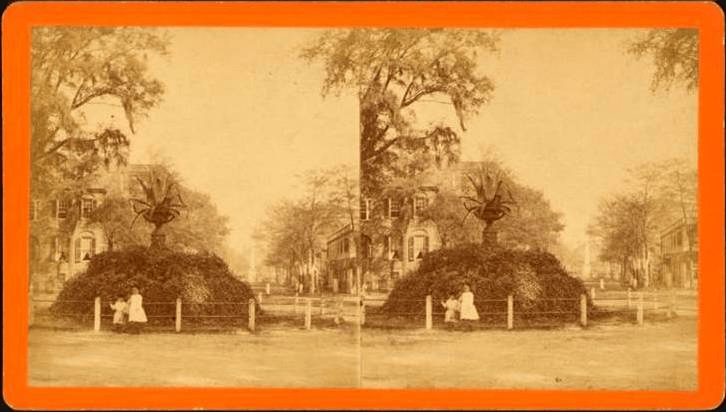
For about five years, Oglethorpe receives significant assistance from Tomochichi in navigating the unfamiliar terrain, and negotiating with the tribes of indigenous peoples and the Spanish, who have established themselves in St. Augustine, Florida, and seek to claim the area as their own. When they attacked, Chief Tomochichi and Oglethorpe respond with alliances able to drive them back with such determination that the Spanish would never again attack anywhere along the Eastern coast of North America. Oglethorpe becomes a hero in England and his partnership with Tomochichi was key; Oglethorpe knew it and held him in the highest regard, using his status and privilege to take Tomochichi to England where he met with the king and successfully advocated for indigenous populations impacted by European settlers. Savannah would thrive with the interconnectedness and cooperation. When the Chief dies in 1739, Oglethorpe bestows highest honors, a public funeral with an English military ceremony, and internment in the center of the city at what is now Wright Square, his grave marked respectfully with a mound of stones, appropriate to his cultural traditions.
The vision for Georgia struggles after Tomochichi’s passing and never fully materializes. No one incarcerated in England was ever brought to the area and freed. The focus drifts away from creating community, trade expands, the forced labor of kidnapped and enslaved Africans begins; about ten years after Tomochichi’s passing, Oglethorpe leaves Savannah and the experiment is over, Georgia officially becomes an English colony.
Chief Tomochichi’s grave was desecrated shortly after the American Civil War. His marker was removed, although his body was not, and a 47-foot monument to William Gordon, founder of the Central of Georgia Railroad Company, now part of Norfolk Southern Railway, was installed on his grave in Wright Square. It remains today. Gordon’s daughter-in-law and the Colonial Dames would step in 15 years later to place a boulder with a bronze plaque in tribute to Chief Tomochichi adjacent to the square so that his memory would not be lost. Norfolk Southern continues to operate in the state and in 2020 boasted nearly $10 billion in operating revenue, not one dime of which was directed to righting or acknowledging this wrong.

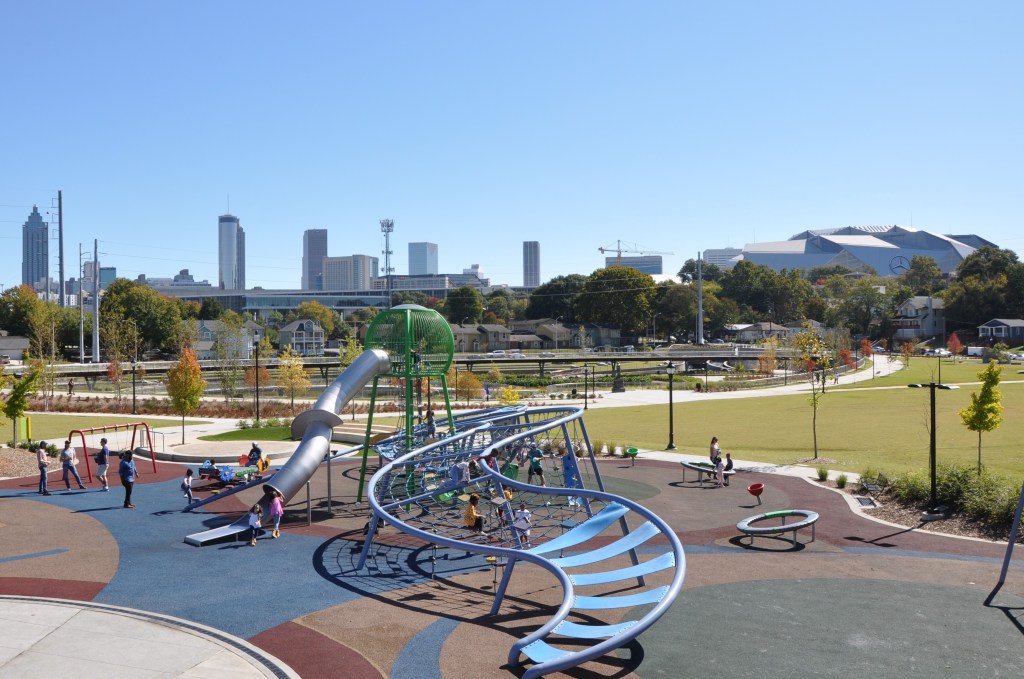
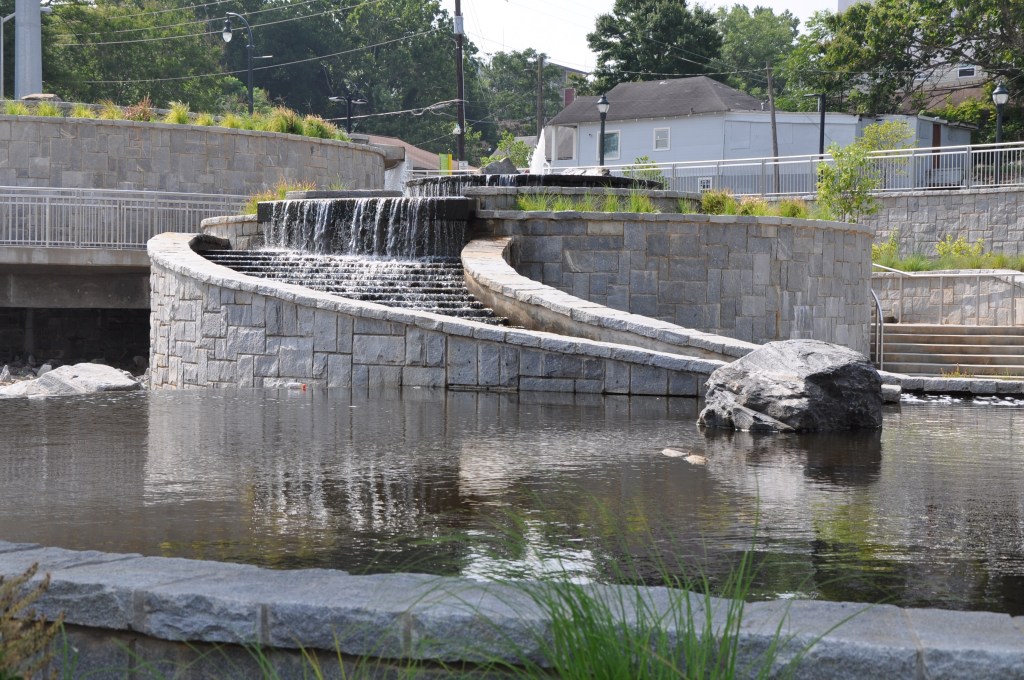
His new memorial will be the centerpiece of Rodney Mims Cook, Sr. Peace Park, standing atop an 80-foot column with a view of the surrounding community. The plans for the park are impressive- 18 memorials recognizing those who prioritized peace and cooperation, a library housing the collections of C.T. Vivian and Martin Luther King, Jr., a playground and basketball court, and a retaining pond that is both beautiful and functional, helping to curb flooding and control rain and sewage that were previously allowed to flow unchecked into the Chattahoochee River. (Atlanta is perpetually in trouble with the FDA over its sewage discharge.) The Park will also provide some much-needed recreation and green space to a neighborhood that lost its gorgeous Historic Mims Park, designed by Frederick Law Olmsted’s firm, when local officials plowed it over in the 1950s for a white elementary school rather than accept a racially-integrated park.

Congressman John Lewis was the first to have a statue installed in the park. Ambassador Andrew Young attended the unveiling and will later have his own memorial, alongside C.T. Vivian, Julian Bond, Martin Luther King Jr., and others. Initially conceived as a replacement to the destroyed park, Atlanta’s culture has shifted enough that renaming it Historic Mims Park after Livingston Mims, an Atlanta mayor who served in the confederate army, was not an option. Instead, the park is named for his descendant, Rodney Mims Cook, Sr., who advocated for Civil Rights and stood up to white supremacy as city Alderman and in the Georgia House of Representatives. He didn’t back down when the KKK burned a cross in his yard and threatened the lives of his children for speaking out against the unconstitutional Peyton Road barricade installed to keep Blacks from moving into or traveling through white areas of Atlanta. Naming a park after such a person, and educating others about their efforts, is especially important now, as we face similar pressure to embrace a hierarchal society that elevates whites over all others.
Cook, Jr., head of the National Monuments Foundation, also gave us the Millennium Gate Museum, with its focus on art and history and ambitious plans to create a program for peace studies to counter the message that only war is profitable. The family has a long and complex history in the state and appears to be using their privilege to move us all forward, something not commonly found in the area. It’s nice to see some of the money the Federal government paid to the Old South finally doing some good.


Notes
https://www.georgiaencyclopedia.org/articles/history-archaeology/tomochichi-ca-1644-1739
https://www.georgiaencyclopedia.org/articles/government-politics/james-oglethorpe-1696-1785/
https://savannahga.gov/facilities/facility/details/Wright-Square-191
http://www.nscorp.com/content/nscorp/en/investor-relations/financial-reports/annual-reports.html
https://www.thenmf.org/projects/sculpture
https://apsforgotten.wordpress.com/2018/04/24/aps-along-the-racial-lines/
https://www.hdrinc.com/portfolio/rodney-cook-sr-park-historic-vine-city
 Debby Yoder