Douglasville, GA- Governor Brian Kemp has appointed former Douglas County Sheriff Phil Miller as Chair of the County Commission and local football hero and Navy veteran Ricky Dobbs to fill a Commission seat after suspending two elected officials who have been charged with bid rigging. In doing so, he has overturned the will of the voters and shifted the balance of power away from Democrats who hold the majority in Douglas County.
Republican Phil Miller’s tenure as Sheriff was problematic for a number of reasons, including the deaths of several inmates in his custody and manslaughter charges for the deputies assigned to protect them. Miller retired in 2016 after siding with a Duck Dynasty cast member when he was sanctioned by the network for bigoted comments. Miller, as Sheriff, put his personal beliefs ahead of his duty to the County and cancelled all business with the A&E network. In doing so, he cost Douglas County an opportunity to participate in Georgia’s developing movie industry- A&E had filmed six projects in the area and more were planned. In choosing him, Kemp has selected a man willing to ignore the people he represents in order to further his own beliefs.
Dobbs played football and basketball for Douglas County High School and graduated in 2006; he was nicknamed the Mayor of Douglasville for his interactions with classmates. He became a starting quarterback for the Navy and was honored at the White House several times for his accomplishments on the field. He was reported in 2009 by the New York Times as being a Democrat, considering President Obama a hero, and having aspirations to run for president in 2040. Dobbs, who now teaches at Douglas County High School, recently refused to reveal his political affiliation, stating “I have a more of an independent view because I agree with a lot of things with both parties and I feel like that’s the way the American people in general (feel).” It is reported he attends local Republican meetings.
With these appointments, Kemp has shifted the balance of power in the county and overturned the will of the voters who elected a Democratic majority. Kemp’s actions in Douglas County should give us all pause. He has overridden the will of the people. If we do not stand up to him for this now, he will feel empowered to do so again when the stakes are much higher.
I met the Thin Blue Line while working in juvenile justice. The program is grant-funded and operates parallel to the system of supervision. It is designed to be rehabilitative and keep kids out of the adult carceral system by improving communication, teaching aggression replacement, and sharing general life skills. Watching the adults manipulate the system at the students’ expense just reinforced the cynicism I feel toward authority. The students knew enough not to trust it. I was more naïve. I really thought I could do some good.
The programs are nationally tested and rely heavily on the competence of the facilitators, yet the program had employed for 4+ years someone the administrator, Christine, described as “dead weight” and a drag on the system. She reported being “stuck” with him and finding it politically contentious to remove him because his mother worked in another part of the county government. She felt her job would be in jeopardy if she addressed the problems with his performance and asked me to help him improve (I know now I should have seen this as a red flag, but, again, I’m naïve and hope for the best.) Reading his nightly field notes made it difficult to imagine he was a graduate student, but knowing the negative evaluations of online programs similar to the one in which he was enrolled explained a lot. We shared notes back and forth for months, but he made no effort to get the details correct or improve his performance. I was very frustrated with him, and her for allowing this to continue. He was nice enough, but didn’t stick to the material when he taught. He would often get off track trying to make the lessons relatable and be unable to find his way back to the material. When I finally put it in writing via email that instructor competency was critical, and that without it the program actually harms students, the director found my documentation to be the problem. My co-worker’s response was thoughtful and well-written, and I wondered why he didn’t put that same effort into his work with our students; Christine advised his mother had written it for him.
She had difficulty clarifying program guidelines and expectations. Being vague always makes me uncomfortable. We held students accountable to a specific set of behaviors, yet Christine couldn’t specify what they were. The student who wore his gang-related black ninja-style ski mask was described as wearing a Covid mask despite the fact that his face was the only thing it didn’t cover because she wanted to get him through the program. It didn’t matter that we had to remove him from the class regularly for inappropriate behavior- including threatening the instructors and mimicking shooting me. She ignored the few clearly established behavioral/safety protocols because annual program completion numbers were down and she needed another graduate. What message does that send? Threatening and bullying get you what you want. It was difficult to maintain any sense of legitimacy with the other students.
??????????
I really liked most of the kids. I identified with them. They are struggling to find their place in a world that doesn’t want to include them. They know it and are doing their best to carve out something, anything. They have extreme loyalty to the people close to them and little concern for anyone else. They stay high to manage the day. This was me in high school and a good portion of the time after. It is a difficult place to be. We had a particularly challenging student in my first cohort. Her older sister had been through the program a few years prior and there were reports of struggles in the home. They lived in an affluent neighborhood in our generally poor county and I am aware money masks a lot of problems. It was speculated she had undiagnosed mental health challenges. I’m no professional, but I couldn’t see it. (This description was floated by our program director often; it always felt like a way to separate herself from the students.) This kid worked hard to be oppositional as often as possible. She was hurting and it showed. She craved and demanded attention, but didn’t trust it. Smart and manipulative, she managed to work herself into a difficult position. Her probation was scheduled to end during the program and she thought that she wouldn’t be expected to finish so she used her two allotted absences at the anticipated end of her probation. When her P.O. extended supervision until she completed the program, she faced an impossible choice- scheduled for the same day were the family celebration and her sister’s high school graduation and our last class meeting. If she missed class, she’d have to start the 10-week program from the beginning and/or face additional punishments from probation. She realized what she had done and struggled with the impossible choice for a couple weeks, her behavior escalating steadily. When I realized it, I shared with my coworkers that I thought she was trying to get us to expel her, saving her a difficult decision. We debated the options, I thought she would benefit from another 10 weeks with us, but no one else could stand the idea of having her around. She seemed like a kid who desperately needed a win, maybe more so than anyone I’ve ever known, so I asked the program director if we could offer her the final class in a special session a day early while we taught another class, allowing her to both complete the program and be part of the important family milestone. To my surprise, she agreed. It seemed uncharacteristically generous, but I assumed it was because she didn’t want her around for another cohort. Christine insisted we should tell the student that this solution was my idea, a recognition I did not want, I thought credit should go to the entire team, but Christine did it anyway. When we presented the idea to our student, she readily accepted. Her behavior shifted a bit during the final weeks, not as much as I had hoped, but change takes time and progress is always slower than I’d like. I was optimistic. I thought we had demonstrated the world can sometimes do nice things and that people aren’t always out to make your life difficult. The last day broke my heart. Our student showed up happy and ready to accept her win, but the program director had a flex waiting for her. Every other student got a giant gift bag for completing their program and our girl had to sit there as the only kid without a gift. She struggled to manage her emotions for several hours, she didn’t want anyone to see how it had hurt her. I hated the program manager for it and struggled to manage my emotions, too. I know we harmed that child. And she did it intentionally.
Our after-school programs were conducted at a county building that also housed the 4-H Club and Senior Services/Meals on Wheels and our students were considered a problem by both programs. They were never invited to any of their events and were viewed suspiciously by all who encountered them. Juvenile justice is designed to be rehabilitative, but these additional punishments made clear there would be no such opportunities. A county van picked the students up for class at home a few minutes after their school busses dropped them off and they would arrive hungry and frustrated after spending anywhere from one to three hours on an uncomfortable bus without climate control. We provided snacks, generally ramen noodles and chips, to help sustain them during the active class work, but it never seemed to be enough. The van was manned by two drivers who thought like people expecting trouble- they collected student’s cellphones so they couldn’t send the van’s location to their friends and varied the route to avoid an ambush. LeRoy was a retired truck driver and Mr. Jett a retired corrections officer. They did not think well of our students; having been around much longer than I, they did not believe in the redemptive qualities of the program. LeRoy was divorced and bitter, and struggled with diabetes and other health problems. Even though he was in his late 50s, he paid extra attention to the young women he found attractive. It was obvious and made things uncomfortable. We are the same age and when I suggested we should occupy a role closer to grandparent than potential partner he was highly offended. I was told Mr. Jett had worked in corrections since the old Alabama chain gang days and had been part of making problem inmates disappear, their records vanishing along with them, their families never knowing what happened to their loved ones. I wondered why she would have someone like working with young adults.
The drivers liked to take their time departing the building after class. They laughed and talked and were in no hurry to get going. The students would often stand around the locked van for an extended period. It felt like a power play, the students were all anxious to get home, but knew it would be another hour or two before the van dropped them off, depending on the route. The drivers worked this to their advantage and used being the first to be dropped off as an incentive and the last as a punishment. Waiting to get on the van was establishing who was in control. One night while we cleaned up the classroom and this played out, I heard LeRoy telling a young man with sagging pants to pull them up and, when he resisted, saying something to the effect of, “You know what that means in prison. It means you’re open for business. Is that what you want to be saying?” I was shocked. I didn’t know what to do, but knew I had to do something when an adult was using homophobia and sexual innuendo with a student in his charge. I responded that he shouldn’t be using homophobia to correct behavior and LeRoy got angry. He tried to get me to agree with his assessment of what sagging pants mean, but I struggled to explain I understood the trend to have started in California as a show of solidarity with the incarcerated who are not allowed belts, but that it had since evolved into a style of its own. LeRoy was generally disgusted and muttered some things I couldn’t understand before stating something to the effect of, “You were giving him a hard time about Chick-Fil-A, but the boy just wanted to find a job.” The statement made no sense so I asked who he was talking about and he adjusted it to say I had made someone feel bad about having previously worked at Chick-Fil-A. It still made no sense. When I again asked what he was talking about, he began to yell at me and explain that his brother is a prison warden so he knows what happens inside. As he ranted, I wondered if his diabetes was making him behave erratically. He was yelling at me in front of our students. I stood squared to him, but chose not to engage with his anger. After a moment of staring at me, he turned and walked out the door, muttering something I could not understand. I wasn’t sure I should let the students get on the bus with him. Mr. Jett assured me it was okay.
I was shocked.
Shocked by his comments to the student, at having been yelled at, wondering what Chick-Fil-A had to do with any of it, but recognizing their general homophobia made their inclusion somewhat understandable, and wondering whether LeRoy was experiencing some type of diabetic issue. None of it made any sense.
I immediately went to the program director’s office to report what had happened. The van was still outside and I wasn’t sure LeRoy should be on the van with our students. Christine listened intently as I relayed the story and immediately began apologizing for LeRoy’s comments. She explained they had all for some time used this same rhetoric to address student’s sagging pants and she had not realized it was homophobic. She reported hearing it often, even on the radio, without questioning it and apologized to me several times. I believed she meant it.
The next afternoon I received an email asking me to reply privately to her with a description of the events. I shared the story assuming this was an issue for human resources to resolve. When LeRoy was copied on the following day’s email asking everyone to attend a team meeting, I knew there was trouble.
Team meetings had been infrequent in my tenure, but generally utilized a sign in sheet with the agenda listed. Because I take notes in meetings, I would request a copy of the agenda. At this meeting, Christine was for the first time oppositional to my request, stating she would need to check with Jill, the county-level program supervisor to see if it was okay to give me a copy. I recognized she was sending a message. Christine talked for 90-minutes about a number of changes we were implementing without addressing LeRoy’s behavior, including increased use of student sanctions for issues with offenses, specifically citing homework completion and improper language as concerns. The student dress code was also to be emphasized and henceforth should be followed to the letter, including zero tolerance for sagging pants and providing zip ties or loaning oversized t-shirts to address the problem. She acknowledged students wouldn’t like it, but explained that would help to curb the behavior. Facilitators would no longer share class notes and we would stop using the program fidelity checklists in class (she specifically explained this was because I had noticed and documented our grad student skipping a section of the program the previous week.) Christine announced she would instead begin to conduct classroom observations herself and would roll out an evaluation process to be conducted after each cohort of students. For the agenda item “Peer relationships (respecting each other and differences, staying in your lane)” she read a statement on personal gain and reminded us that we cannot use the program to advance a personal agenda. She cited as an example, “Say I didn’t believe in marriage” and explained we cannot project our beliefs onto students. From there a 40-minute discussion of the “confrontation” between LeRoy and I commenced. It was determined that we were both equally wrong, him for having used homophobia and sexual innuendo with the students, and me for having addressed it in front of the students. We were instructed to work it out between us.
During the discussion many telling comments were made. The “dead weight” facilitator explained he thought the problem was that LeRoy and I were both old and set in our ways, so the disagreement got out of control. The former corrections officer thought the problem was that this situation was likely to become known outside the building and that when people learn what’s going on, programs like this tend to go away. He stated that even though he had a pension, he like the “little money” he got here. The facilitator who had not been present during the event had a strong feeling that the problem was simply that it happened in front of the students.
The next week brought more changes, the student who had been assigned to me, and who was coming in early before most classes to talk about the happenings in his life, would no longer be allowed to talk with me. He would need to sit in the driver’s room outside Christine’s office and watch TV. The facilitator who had not been present stopped speaking to me completely. She would avoid being in the same room with me and stopped assisting/participating when I was the lead instructor. The program director began leaving the building once the students arrived and stopped responding to my emails, including questions about dates for trainings I had been asked to attend and a request for clarity about the “personal gain” clause. After a week of ostracization and increasing hostility, I emailed my intent to resign at the end of the program; an out of office auto-reply informed my supervisor would be absent for a week, something that had not previously been shared with me.
I finished out the week and didn’t go back. It was clear I was not welcome. They had circled the wagons to protect LeRoy, even while acknowledging he was wrong. They had admittedly all been doing the same thing and it is likely they just didn’t want to address their own behavior. Bigotry and the resulting privileges are tough to give up. But, what about the students? These folkx know they are harming them and do not care. They personally benefit, so they continue doing it, despite the harm and having been tasked with protecting the students. It is the school-to-prison pipeline and prison industrial complex at work, protected by a version of the thin blue line. I think our kids deserve better.
Three months later, I passed the van driving through the community; it was loaded with students and LeRoy was at the wheel. It re-opened the wound and I reached out to the state-level administrator about his continued supervision of students. Her polite, two-sentence email let me know she was holding the line.
Atlanta- The first of three weeks of Georgia’s Advance Voting ended with predictably high turnout. The strong early numbers would typically excite me, but my experience working the polls has me concerned. My county has voted blue the last few elections, but this time the republicans seem to bringing the numbers. Their behavior in the precinct indicates they don’t understand how our government is structured and yet they’re overly confident they’ll be the hero who finds fraud in the system.
Some (generally, white) voters question every step you make. They require explanation for each move but lack understanding of the system. We have to calmly explain to the suspicious how our government is structured and why they can’t vote for the extreme candidate in another district. They take down our names and try to illegally photograph the voting machines and layout of the precinct. They’re collecting evidence as if we’re trying to cheat them.
My assigned precinct is staffed by people of color and one big white dyke (me, of course.) This causes great concern for rural whites who are convinced minorities are stealing their birthright. One older white man promised to come back and vote again in a few hours so “the n***** don’t take over.” I was shocked by his language and explained that would constitute fraud which carries significant criminal and financial penalties. For a moment he had seen me as an ally, something I was unaware of until I watched anger and betrayal take over his face. I am an honorary white, only welcomed when whites are in the minority. Most times, being gay relegates me to second-class citizen.
Older white people often treat me as suspect, as when I simply asked whether a voter is Junior or Senior, because their driver’s license and voter registration were not an “exact match.” (Georgia recently purged more than 300,000 voters, mostly people of color, for failing to meet this standard, but this name was not one of them.) The woman accompanying him defended him with, “Don’t you try to stop us from voting.” If the purge had been conducted fairly, he would have been removed. His license said one thing, his voter registration another, but neither are correct, he is actually the third in his family to carry the name. Rather than understanding their white privilege kept them in the system, they viewed my question as someone trying to take something from them. They view our activities through this lens.
Another man responded with frustration when his candidate did not have a number one behind his name, as his other choices did. He wanted us to change the entire system to include the number one he thought his candidate deserved. It took a minute to realize he meant the (I) for incumbent. When I explained what the “I” stood for, and then had to tell him what the word meant, he responded as if I was trying to trick him. He would return later with a notepad, taking down names, and pressing the precinct manager for details, making promises to follow up if things didn’t go “right.” He never noticed he was not supposed to be in the building at all. (Only poll workers, poll watchers, and active voters are allowed.) Answering his questions was a courtesy extended to quell any potential dissatisfaction over the election outcome.
Heading in to week two has me a bit concerned. Progressives, please get your people to the polls. The other side is fired up, ready to fight, and showing up at the polls. We have to be equally intentional.
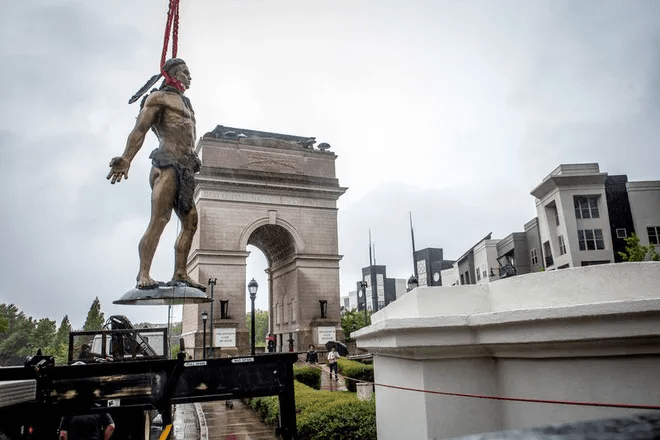
Chief Tomochichi stands proudly at the Millennium Gate Museum at Atlantic Station, his home for the next year or so while they ready his permanent placement at Rodney Cook, Sr. Peace Park in West End. The first photos I saw in the Atlanta Journal-Constitution struck me as wrong, the statue was prone, almost hog-tied with his arms wrapped while they brought him upright. In the next, the rope was positioned around his neck like a noose and he hangs in the air between the truck that delivered him and the pedestal on which he will stand. In some images, white men in hunting camouflage look on. It all feels problematic given the disastrous history of colonization and the attempted genocide of native populations.
Photo by Steve Schaefer for the Atlanta Journal-Constitution
Chief Tomochichi’s recorded history begins in the early 1700s, when European settlers arrive near Savannah, and “discover” his tribe of about 200 established on the nearby bluffs. The English, while generally thought of as the world’s historians, did not document much of what they found, focusing instead on their efforts to establish a society very different from the one they had left behind. They were led by General James Oglethorpe, a social reformer with a special mission, he hoped to empty the English jails, filled primarily with the poor who were imprisoned because couldn’t pay their debt. He planned to establish a community without social classes, where all were welcomed and able to establish a comfortable life free from religion and enslavement. Oglethorpe’s vision was a marked departure from plantation settlements and their goals for individual wealth. The motto for Georgia was Non sibi sed aliis, Not for self, but for others.
Photo by Steve Schaefer for the Atlanta Journal-Constitution
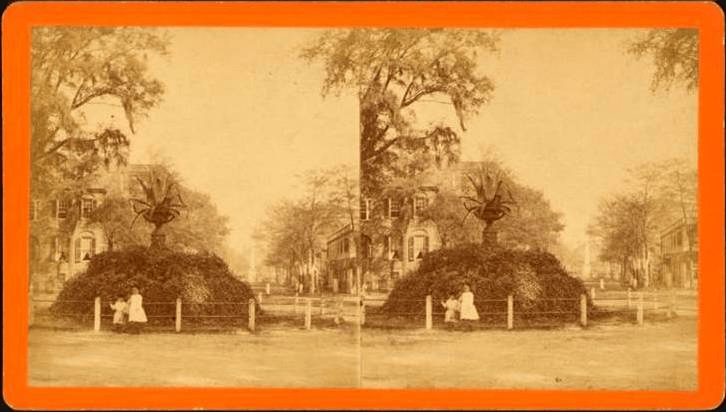
For about five years, Oglethorpe receives significant assistance from Tomochichi in navigating the unfamiliar terrain, and negotiating with the tribes of indigenous peoples and the Spanish, who have established themselves in St. Augustine, Florida, and seek to claim the area as their own. When they attacked, Chief Tomochichi and Oglethorpe respond with alliances able to drive them back with such determination that the Spanish would never again attack anywhere along the Eastern coast of North America. Oglethorpe becomes a hero in England and his partnership with Tomochichi was key; Oglethorpe knew it and held him in the highest regard, using his status and privilege to take Tomochichi to England where he met with the king and successfully advocated for indigenous populations impacted by European settlers. Savannah would thrive with the interconnectedness and cooperation. When the Chief dies in 1739, Oglethorpe bestows highest honors, a public funeral with an English military ceremony, and internment in the center of the city at what is now Wright Square, his grave marked respectfully with a mound of stones, appropriate to his cultural traditions.
Stereograph courtesy SCAD Architectural History Blog
The vision for Georgia struggles after Tomochichi’s passing and never fully materializes. No one incarcerated in England was ever brought to the area and freed. The focus drifts away from creating community, trade expands, the forced labor of kidnapped and enslaved Africans begins; about ten years after Tomochichi’s passing, Oglethorpe leaves Savannah and the experiment is over, Georgia officially becomes an English colony.
Chief Tomochichi’s grave was desecrated shortly after the American Civil War. His marker was removed, although his body was not, and a 47-foot monument to William Gordon, founder of the Central of Georgia Railroad Company, now part of Norfolk Southern Railway, was installed on his grave in Wright Square. It remains today. Gordon’s daughter-in-law and the Colonial Dames would step in 15 years later to place a boulder with a bronze plaque in tribute to Chief Tomochichi adjacent to the square so that his memory would not be lost. Norfolk Southern continues to operate in the state and in 2020 boasted nearly $10 billion in operating revenue, not one dime of which was directed to righting or acknowledging this wrong.
Artist rendering of proposed column courtesy Intown Newspapers
His new memorial will be the centerpiece of Rodney Mims Cook, Sr. Peace Park, standing atop an 80-foot column with a view of the surrounding community. The plans for the park are impressive- 18 memorials recognizing those who prioritized peace and cooperation, a library housing the collections of C.T. Vivian and Martin Luther King, Jr., a playground and basketball court, and a retaining pond that is both beautiful and functional, helping to curb flooding and control rain and sewage that were previously allowed to flow unchecked into the Chattahoochee River. (Atlanta is perpetually in trouble with the FDA over its sewage discharge.) The Park will also provide some much-needed recreation and green space to a neighborhood that lost its gorgeous Historic Mims Park, designed by Frederick Law Olmsted’s firm, when local officials plowed it over in the 1950s for a white elementary school rather than accept a racially-integrated park.
Congressman John Lewis was the first to have a statue installed in the park. Ambassador Andrew Young attended the unveiling and will later have his own memorial, alongside C.T. Vivian, Julian Bond, Martin Luther King Jr., and others. Initially conceived as a replacement to the destroyed park, Atlanta’s culture has shifted enough that renaming it Historic Mims Park after Livingston Mims, an Atlanta mayor who served in the confederate army, was not an option. Instead, the park is named for his descendant, Rodney Mims Cook, Sr., who advocated for Civil Rights and stood up to white supremacy as city Alderman and in the Georgia House of Representatives. He didn’t back down when the KKK burned a cross in his yard and threatened the lives of his children for speaking out against the unconstitutional Peyton Road barricade installed to keep Blacks from moving into or traveling through white areas of Atlanta. Naming a park after such a person, and educating others about their efforts, is especially important now, as we face similar pressure to embrace a hierarchal society that elevates whites over all others.
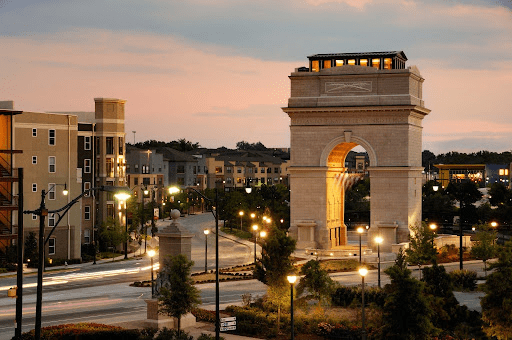
Cook, Jr., head of the National Monuments Foundation, also gave us the Millennium Gate Museum, with its focus on art and history and ambitious plans to create a program for peace studies to counter the message that only war is profitable. The family has a long and complex history in the state and appears to be using their privilege to move us all forward, something not commonly found in the area. It’s nice to see some of the money the Federal government paid to the Old South finally doing some good.
Millennium Gate Museum arch courtesy the gatemuseum.org
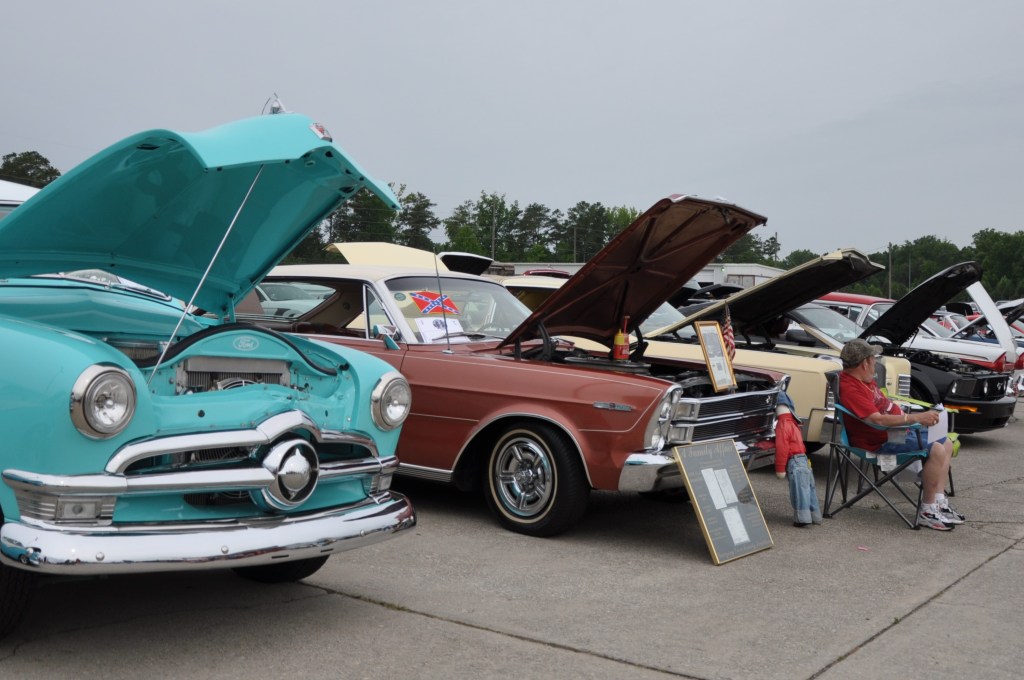
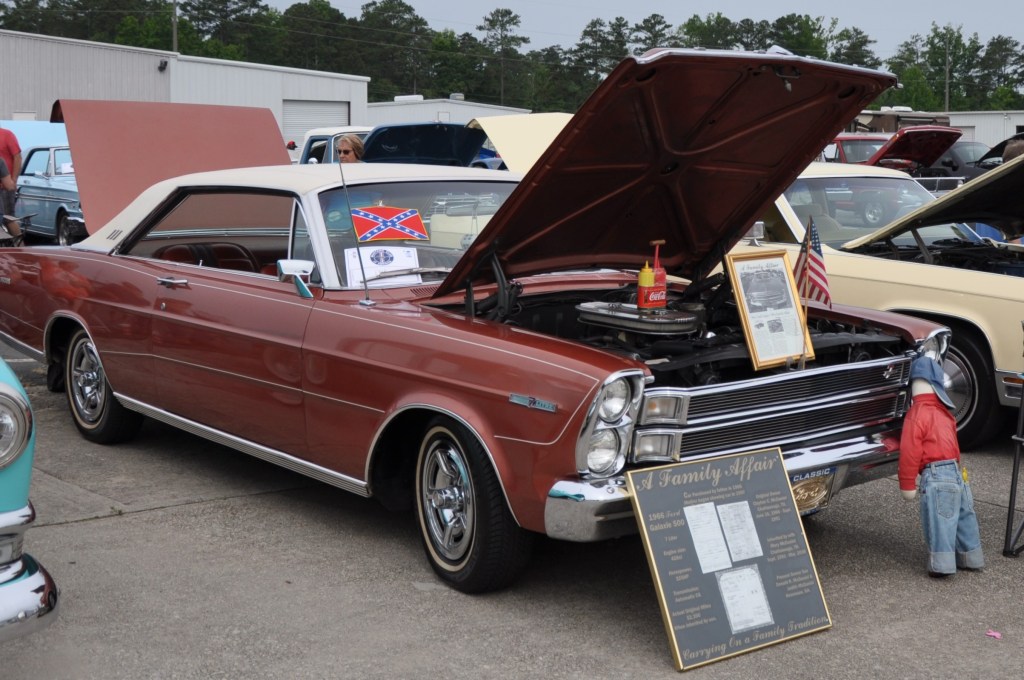
The joy of seeing my favorite old Mustangs at the car show was overshadowed by the presence of the confederate flag. In the west metro Atlanta suburbs, I see it almost every day, but since the insurrection at the U.S. Capitol in January, it feels different. I had become used to the sight, and the outrage the rest of the country felt at seeing it in the Capitol building was a wake-up call. I wonder why we tolerate the traitor’s flag.
Years ago, when I first moved to the suburbs, I, too, was shocked by the confederate flag. I would ask random strangers what the flag meant to them and why they felt the need to display it on their car/truck/person. Never once did I receive an actual answer, “Fuck off, dyke bitch” was the general response. I quit asking because it seemed anyone flying such a flag was not capable of, or was unwilling to, articulate their views.
When I approached the older white men sitting with the rust-colored 1966 Ford Galaxie 500, both seemed shocked that I wanted to talk about the confederate flag prominently displayed on the windshield. The owner reported that he had been displaying the flag for 2 or 3 years, and that no one had ever complained, but he assured me that if anyone did, he would remove it. I made clear that I was complaining, and that he couldn’t say that anymore. He ignored me when I asked him directly to make good on his promise and remove it. When I asked why display it at all, his answer was, “We’re in the south” as if that explained everything.
More disturbing was the confederate flag mounted on the front of a 1992 Mustang used by the Georgia State Patrol. The car is immaculate, having been beautifully restored and generally only used for recruiting purposes. Two uniformed white male officers lingered around a tent with the GSP logo, recruiting banners, a table with cups and water bottles to giveaway, and a poster that read, “Georgia State Patrol Takes One to Catch One.” The car sat next to the tent, with its own informational poster, and bright red confederate flag prominently standing out against the blue car. The officer explained the confederate flag was only present as part of the Georgia State flag, the version displayed on the car was historically accurate for the year of the car. I pointed out the license plate did not reflect the state flag, but simply the state symbol and a confederate flag. (Later, a Google search would reveal a front license plate was never official for GSP vehicles, but this particular plate was commonly added, presumably by the officers who used the car.) I shared with the officer that such an image made me feel unsafe, that citizens needed to know they could trust law enforcement to be impartial, and that such a symbol indicated otherwise. He simply looked at me with a sickening, paternalistic smile, and said, “I can assure you, you’re safe.” When I pushed back, he explained the car was privately owned, that it didn’t belong to the GSP, and they couldn’t control what the owner did with the car. I pointed out that the proximity to the official tent, and the presence of uniformed officers gave the impression of state ownership, and that this looked like state sponsored terrorism. He tried to direct the conversation away from the flag by showing me the computer in the car and telling me how much he would love to patrol in this particular vehicle. I thanked him for his time and moved on, aware he was not interested in my opinion. Later, I realized he hadn’t even tried to recruit me.
I wonder about the effect of such conversations. A few years ago, I had a similar exchange about the flag at a car show, and later an older white man who overheard it approached me to thank me for pointing out the impact the flag had on me. He expressed regret that he had not thought of it from my perspective and vowed to respond differently to the flag moving forward. It is my hope that leading with my vulnerability allows others to see me as human and understand how their behavior is harmful. I fear that it empowers and emboldens those who display this flag with the intent to intimidate minorities like me.
From the interstate, I saw the banner hanging on the overpass fence and was immediately outraged. How dare someone hang it in my community? Unacceptable.
I saw it on a Saturday afternoon, but admittedly forgot about it until I passed it again the following Tuesday. The upper portions had come undone, but it remained secured to the fence, obvious what it was. I stopped and removed it.
I spread out the 6’ x 14’ cloth banner on my driveway, took photos, and called the police. Google maps showed this bridge to be in the City of Douglasville, so I dialed their number. A kind and interested officer advised the bridge was patrolled by the sheriff’s office, but listened to my concerns about hate groups taking root in our community. I offered to send him a photo of the banner and asked that he make the department aware of it.
Next, I called the sheriff’s office, expressing my concerns to several officers as I was transferred around, eventually reaching the deputy who had been assigned to address the issue that very day, after having received several complaints from the public. He explained that he had not noticed the banner when patrolling or doing his personal driving, so he didn’t think it was a big a deal. He quickly became frustrated with the conversation, responding to my concerns that officers had driven by for several days and not removed it, complicit support for such a group, by making it my fault that I had not reported it immediately, and adding that I was being unreasonable for expecting the police to prevent all crime. I made it clear this was not my expectation, and that I was concerned about support for such a group within the department. He went on to tell me he didn’t think many folkx would have noticed the banner because he keeps his eyes focused on the lane in front of him when he is driving, rarely looking around. I found his comments odd. I ended the call by offering to share a photo of the banner or bring it in, something he did not think necessary, and requesting that he send my concerns up the chain of command. I provided my contact information and asked for a follow up.
I then emailed the photo to the address provided by the Douglasville officer, receiving an immediate response that my message had been blocked.
After eight weeks without follow up, I emailed Douglas County Sheriff Tim Pounds and Douglasville Police Chief Gary Sparks asking what is being done to make sure this doesn’t take root in our community or in their departments. Three weeks have passed without comment.
So, who are these guys and why am I so concerned? Patriot Front, formed after the 2017 unite the right rally in Charlottesville, is widely recognized as a hate group, with ProPublica describing them as “perhaps the most active white supremacist group in the nation” engaging “in a mix of vandalism and intimidation to foster anxiety.” The Anti-Defamation League found them to be “responsible for 80% of racist, antisemitic, and other hateful messages tracked in the U.S. last year,” with their 2020 activity more than doubling that of the prior year. The group is virtually all male, and sees themselves as the most virile and competent of hate groups, poking fun at the Proud Boys and Boogaloo movement. They recruit on college campuses and work to blend into any setting, believing it makes them more threatening when people don’t know who they are, and have to wonder about the stranger next to them in a public setting. Members warn against having girlfriends and advise against sharing their “activism,” citing women as a “weakness” that could hurt the individual and organization. Cautious about sharing their specific goals, the group posted online a manifesto vowing to reclaim the country and celebrating the European ancestors who “conquered” the continent. One member reported white men as “facing the harshest oppression from our ruling elite” and explained this as the reason white men commit mass shootings, calling it “lashing out.”
This is not a group I want to see in my community.
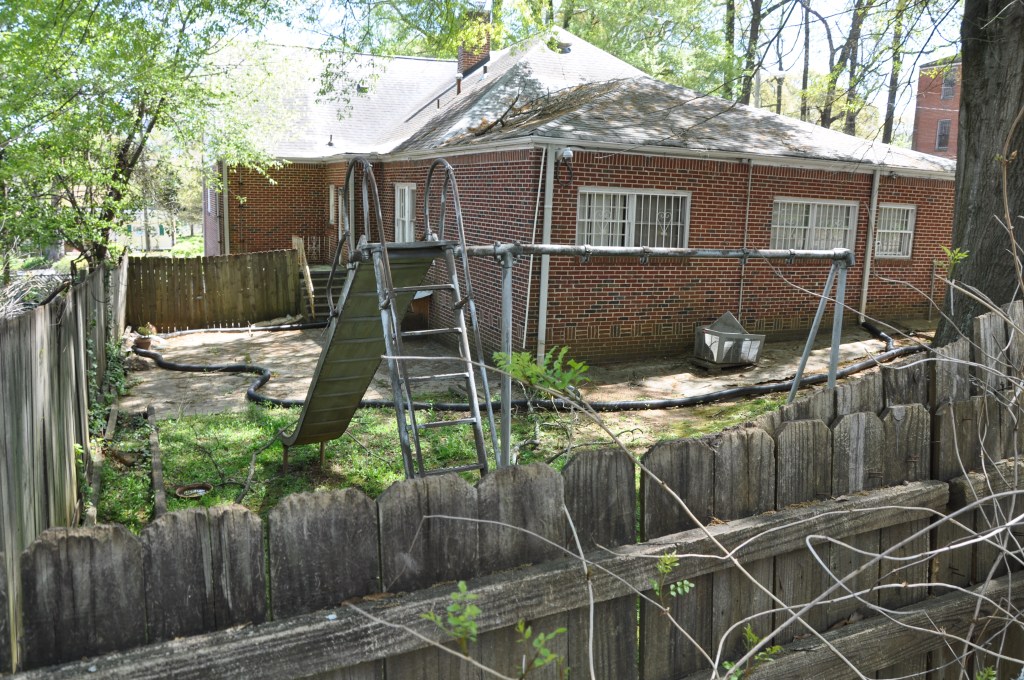
Atlanta- This is the backyard at the home Dr. King bought for his family. Something about this swing set really gets to me. I picture him laughing with his small children and being a regular person and it reminds me any one of us could change the world.
I’ve visited his birth home, Ebenezer Baptist Church, The King Center for Nonviolent Social Change, and The Center for Civil and Human Rights, but I didn’t find him there the way I found him on Sunset Avenue. Those formalized settings introduced me to MLK the Legend, the Icon, the man whose work is larger-than-life. On Sunset Avenue, I found a person, a regular person. Someone who was fed up with the ways things were and decided to do everything in his power to change it. An everyday person, like any of the rest of us.
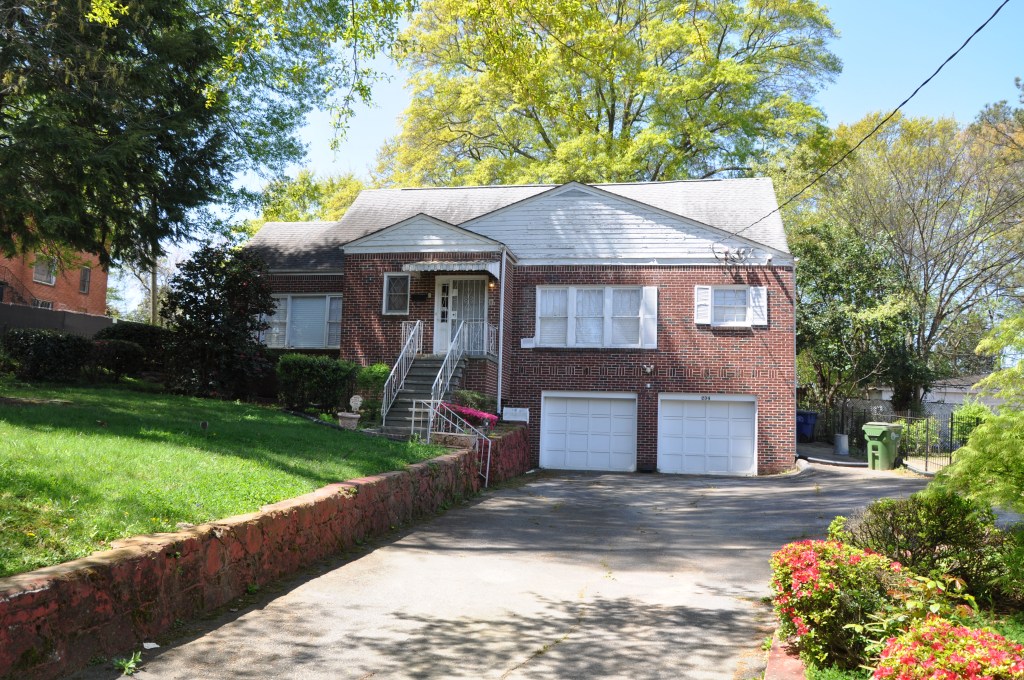
The house is made of brick and sits back from the street. The long driveway dominates the view as it makes a path to the two-car garage. The home feels functional and private. I feel deep reverence for this place. I first visited as an undergraduate Sociology student struggling with what I was learning about Atlanta’s history of racial violence. I desperately needed to know how one continues to strive against seemingly insurmountable forces.
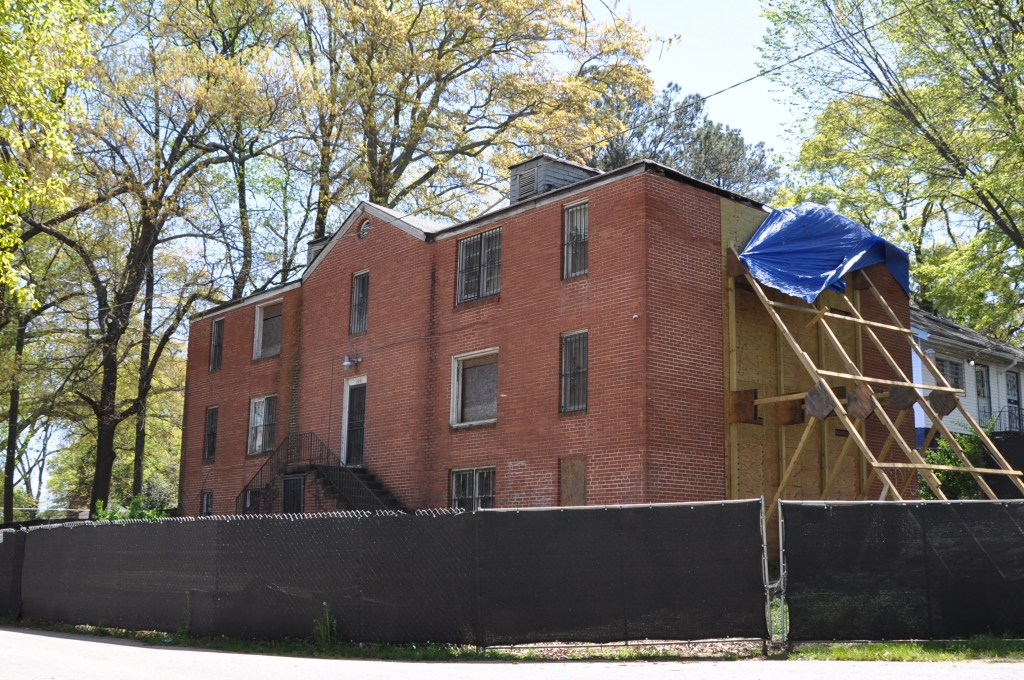
The King family purchased this home in 1965, after renting it for a year. Reports are that Dr. King was wary of ownership, and that it was Mrs. King who insisted, so they put the house in her name. It is situated a few blocks from the cluster of HBCUs that make up the Atlanta University Center, and the original Paschal’s Restaurant and hotel, where Dr. King met regularly and planned much of the Civil Rights Movement and Poor People’s Campaign. Next door is a three-story brick apartment building, currently boarded and decaying, where Maynard Jackson grew up.
The backyard seems small, but secure with its wooden privacy fence. The old swing set dominates the space and I wonder why it remains. The children would have outgrown it decades earlier, so I imagine it carried a sentimental value. Perhaps Dr. King picked it out or the assembly was a favorite family memory. Raised beds and a small shed were installed around it, and portions of the back and side yards were paved to control runoff, but the swing set remained. Maybe Mrs. King liked to remember her husband playing with their small children or perhaps this is the only place the children have actual memories of their father. Its presence lets me imagine Dr. King in ways his larger-than-life legacy does not.
After his murder, Mrs. King remained in their home. In the weeks that followed, she would envision a “living memorial filled with all the vitality that was his, a center of human endeavor, committed to the causes for which he lived and died” and create The King Center in the basement, securing nonprofit status before the year was out. Within a few years, she would buy the apartment building next door and run The King Center offices from there. Her progress would be swift and steady, creating what is now a 23-acre facility managed by the National Park Service.
Their neighborhood would suffer from destructive policy and disinvestment for decades. The State has failed to help the cluster of HBCUs navigate challenging times and the lush campus and its historic buildings are crumbling; appalling because we know they would never similarly ignore the University of Georgia. The drug trade moved in and suddenly a block was all that separated the family home from the hot area known as Tha Bluff. A series of break-ins prompted Oprah Winfrey to move Mrs. King into a 39th floor penthouse apartment in Buckhead in 2005. The next year, neighbor Kathryn Johnston would be murdered in her home when the police drug squad burst in with a no-knock warrant. The subprime mortgage scandal would hit the area hard, the Federal government bailed out the banks that caused the problem, but left the neighborhood in ruins. Today, a few small investments in infrastructure would empower the people and stabilize the community, but proposal after proposal has been ignored. The City did manage to demolish part of the street named in his honor and to divert $33 million in tax revenues approved for other uses to build a pedestrian walkway to the $1.5 billion stadium, all located less than a mile away.
When Mrs. King passed in 2006, she was interred with her husband at The King Center. Their children have continued to serve the community and have expanded the King family legacy to recognize all that their mother accomplished. The family home was recently sold to the National Park Service and will soon be open to the public for tours. I will miss this version of the neighborhood, but hope the change will bring us closer to realizing the Beloved Community. Dr. and Mrs. King believed we can be better than what we are and carried us forward as far as they could, its our job to pick up the baton. They taught us regular people can change the world, let’s get to work.
“Life’s most persistent and urgent question is, ‘What are you doing for others?’”
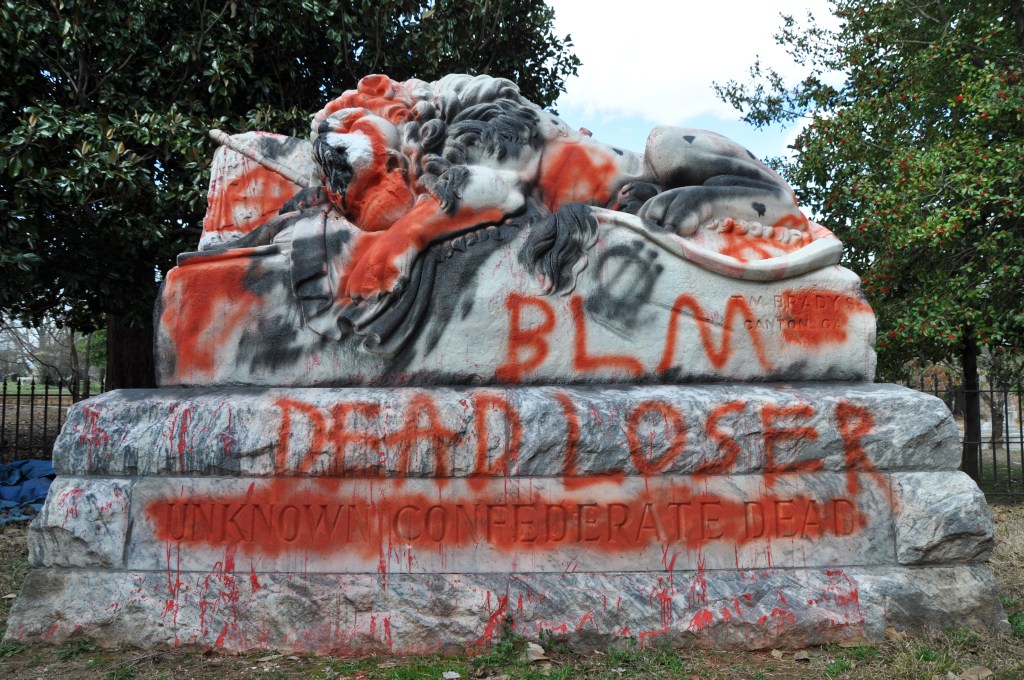
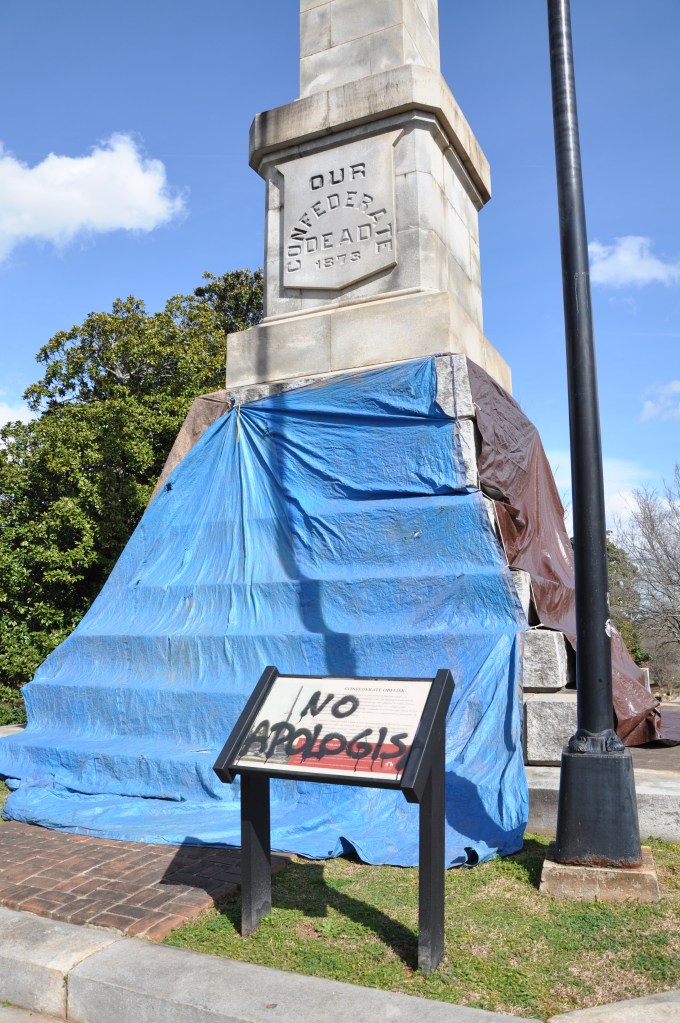
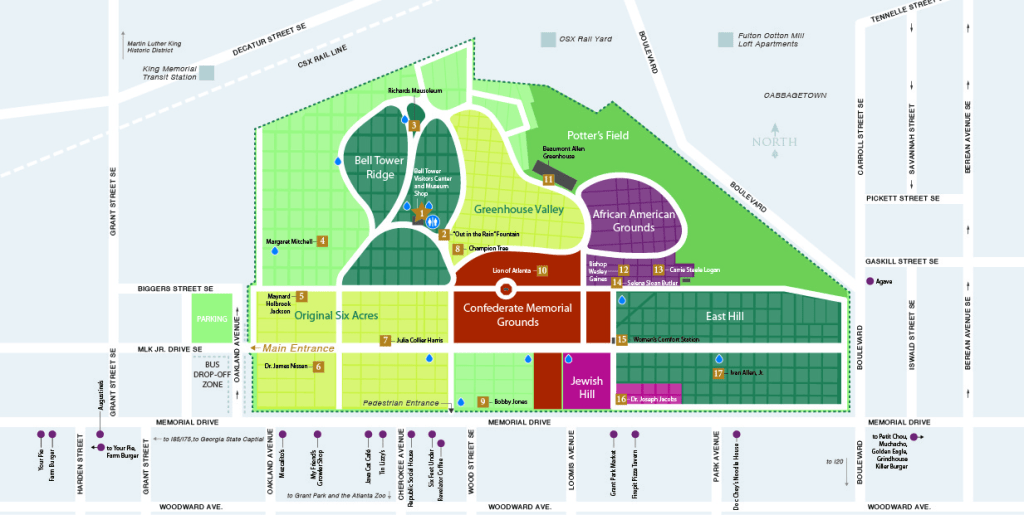
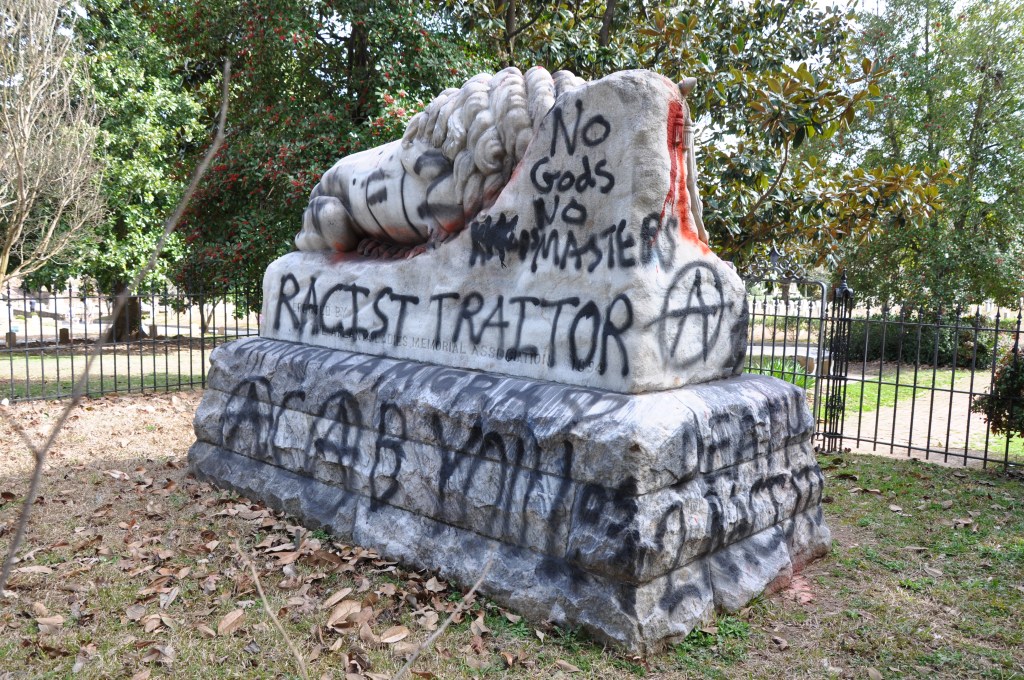
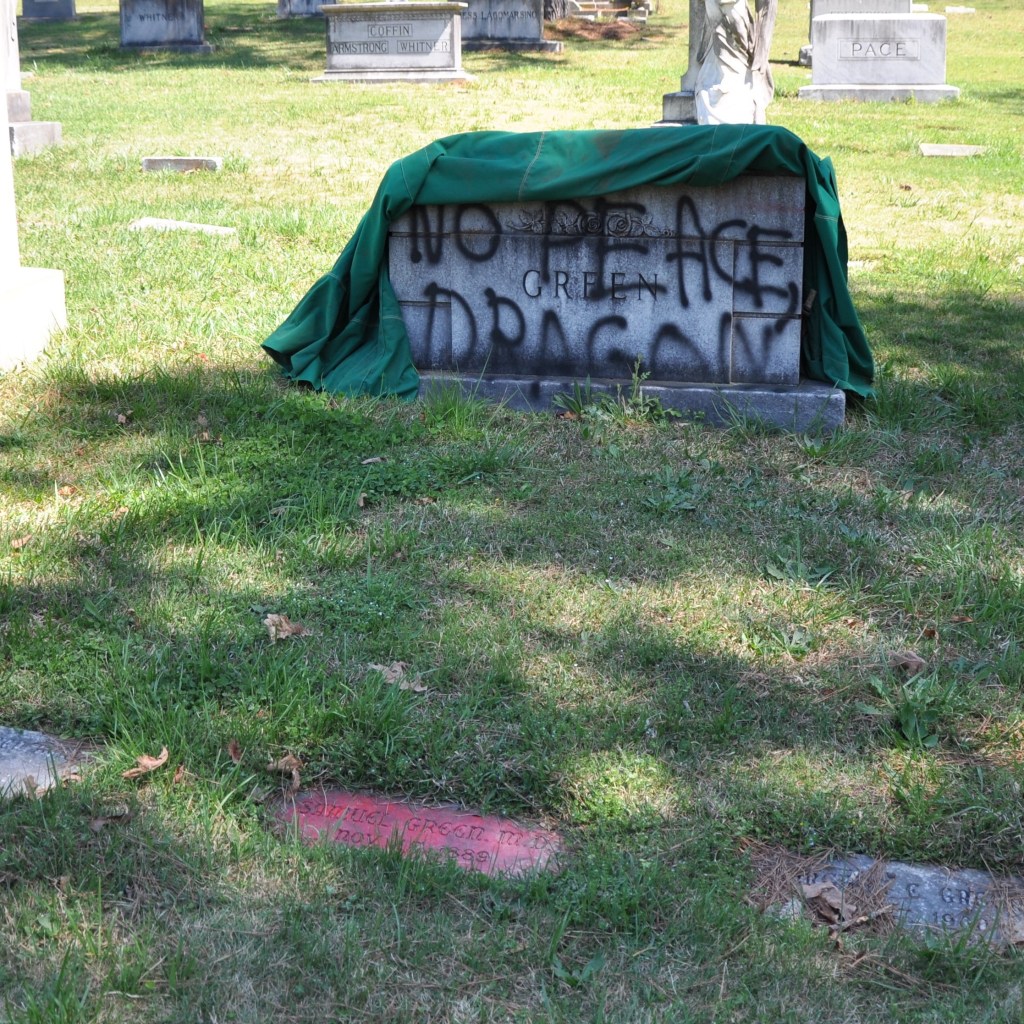
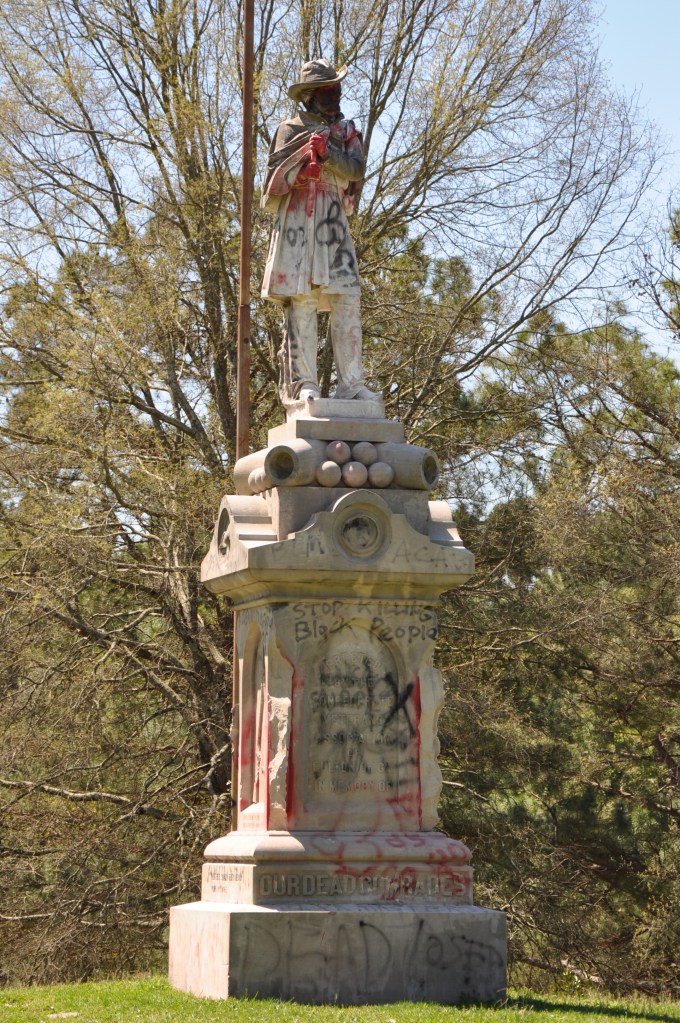
ATLANTA- The confederate monuments at Oakland Cemetery received an update from activists who added “BLM’ and “racist traitor” to the obelisk and Lion of Atlanta. I happened upon it several months later and, after four years of republicans stoking the fires of bigotry, I was thrilled to see the people on the receiving end still fighting to move us forward. It so energized me that I posted photos online to share the experience. I was unprepared for the backlash and reminded that there is no acceptable way to protest and, sadly, of white women’s role in maintaining the patriarchy.
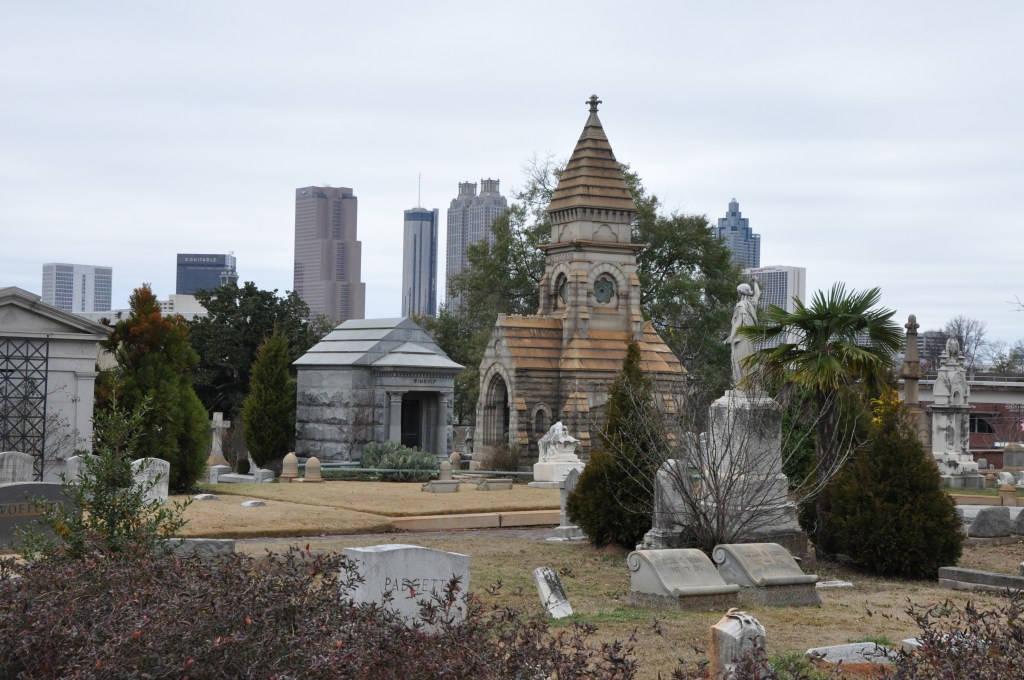
The Victorian garden cemetery stretches for 46 scenic acres in the center of the city. I have often found comfort and serenity in wandering Oakland’s paths, but the confederate monuments have always bothered me. Atlanta likes to think of itself as “the city too busy to hate,” but that has not been my experience. As a masculine gay woman, who identifies as a Big Dyke, I am approached almost daily by people who feel compelled to tell me I’m going to hell if I don’t repent and get right with god. The racism and bigotry here can be quite covert and individual, the State seemingly adopting a “peace at any price” approach, and treating each instance individually to avoid addressing the larger problem and preserve the existing power structure. Although Georgia is 75% urban, rural thinking dominates, empowering bigots and making life difficult for many of us. The confederacy is so common in metro Atlanta that my biggest takeaway from the January republican insurrection at the U.S. Capitol was surprise at the reaction of the rest of the country to the confederate flag in the Capitol; I literally see it on cars and houses every day and even, until recently, on the Georgia state flag. To see it in the U.S. Capitol felt commonplace. It was a wake-up call when others were shocked by the image.
The Lion of Atlanta statue, with its “Unknown Confederate Dead” inscription, sits atop a mass grave that includes more than rebel soldiers. Typhoid was spreading through Atlanta during the Civil War, claiming 60% of the people who contracted it and overwhelming the burial system. Many of the individuals in this mass grave were members of the community, not confederate soldiers. Assuming their beliefs aligned with those who wished to secede from the Union is a mistake, but supports revisionist confederate ideology. The statue itself closely resembles the Lion of Lucerne, and was commissioned more than a decade after Mark Twain described it in his travelogue, yet the sculptor, mayor of nearby Canton, Georgia, claimed his idea was completely original. Atlanta would again copy this work when it carved the confederate soldiers into the side of Stone Mountain- the massive Lion of Lucerne is also cut into the side of a former quarry that now serves as a park. To encounter these garish monuments in an otherwise peaceful environment is offensive and upsetting. I am reminded I am seen as less-than and of the horrors southerners inflicted on people they considered below themselves. That these statues remain, celebrating confederates with minimal counter to the narrative tells me these sentiments persist.
The adjacent 60-foot obelisk was the tallest structure in Atlanta when it was unveiled on confederate memorial day in April, 1874, a holiday the state would recognize (along with Robert E. Lee’s birthday) as such until 2015, when it simply changed the name to “state holiday” and continued to celebrate. The obelisk sits at a crossroads, and is hard to miss at the center of the cemetery. I have often wondered why, when so much of Atlanta was in ruins, they squandered resources on a monument such as this, rather than helping people rebuild homes and businesses. More recently, I’ve come to see the American south as an occupied territory and monuments like this are reminders that white supremacy continues to reign. In 2019, Georgia greatly expanded an existing law that protected military monuments, broadening its reach and prohibiting local governments from moving or altering such monuments, proving racism is alive and well and enjoying state support.
Oakland Cemetery is itself a cautionary tale of white supremacy. It is divided into sections, whites and honorary-whites taking the majority of the space with sections designated for those of African American and Jewish descent. In the original Jewish section, the markers are close together, barely leaving room to walk between graves. The expanded section is better, but separate is still not equal. When the cemetery was created in 1850, African Americans were an enslaved people and buried in what is known as “slave square” at the back of the original six acres. When the cemetery expanded after the Civil War, these graves were in the center, so they moved the individuals to the new Potter’s Field, again at the back of the cemetery, keeping no records and placing no markers. They simply tilled the earth at the original site and sold the plots to white families.
These sections reveal much about life under white supremist rule, reminding us what it means to live and die without being valued by the larger community. Maintenance and upkeep of the cemetery has increased tremendously in recent decades, but in an uneven and hierarchal manner that reminds us that things haven’t changed as much as I’d like and, frankly, as much as I need. Seeing the damage done to these confederate monuments energized my spirit and reminded me I’m not fighting alone. Change is coming.
I posted photos of the damaged monuments to my social media pages in hopes of giving folkx like me, who were beaten down by the last four years of republican treachery, an emotional boost. I was unprepared for the backlash. Most of it was private- messages and emails expressing indignation about “history” being challenged. If you think what you’re saying is correct, why would you whisper it in secret? I am reminded there is no acceptable way to protest. Some, mostly white, people want everyone to just be quiet and accept things as they are; they can do so because the system works for them. The rest of us must fight daily and we know our survival is not guaranteed.
“If we cannot justify the South in the act of Secession, we will go down in History solely as a brave, impulsive but rash people who attempted in an illegal manner to overthrow the Union of our Country.” – Clement A. Evans, brigadier general, confederate states of america
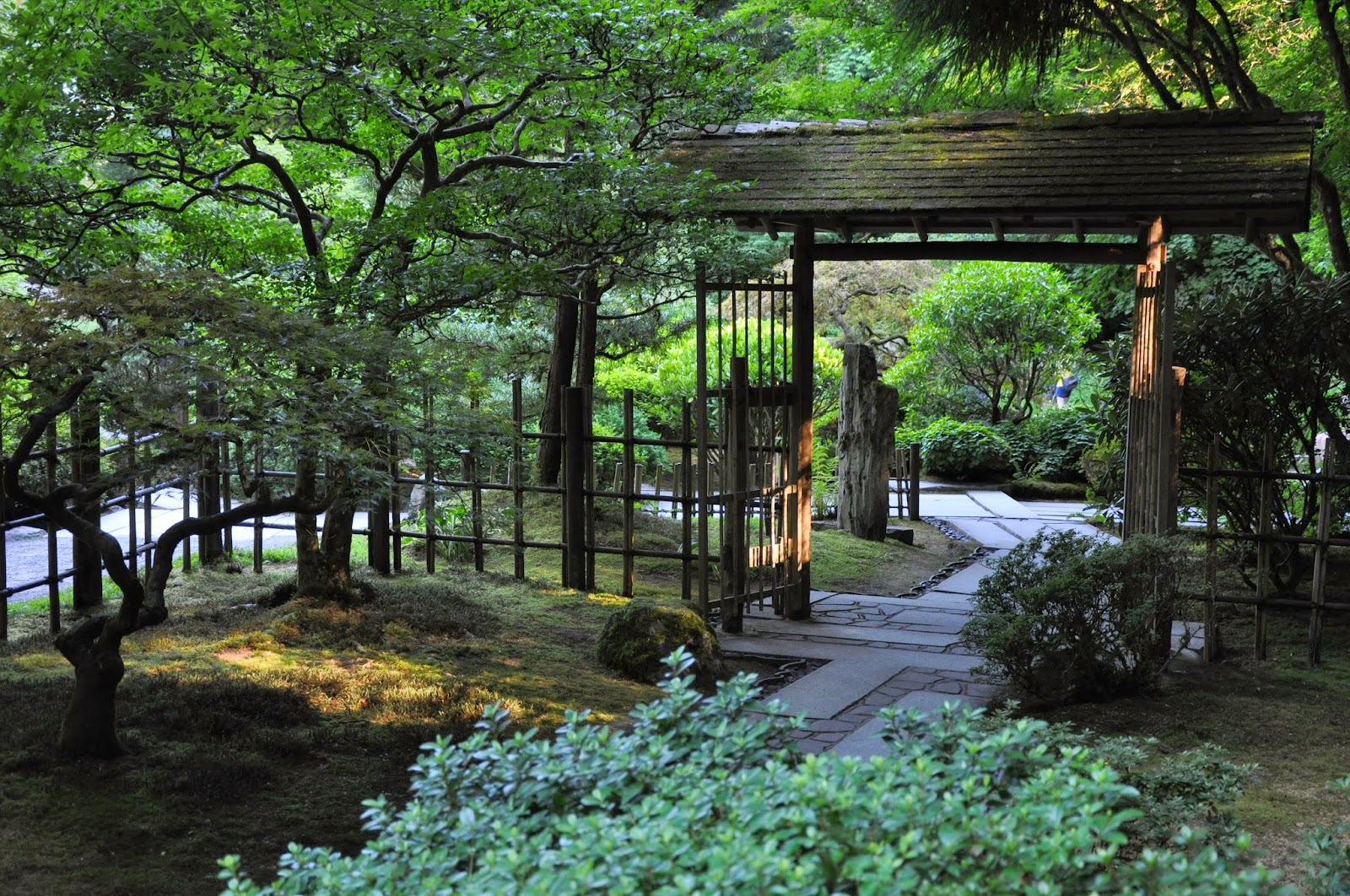
Posted by Debby Yoder, Portland, Oregon — Portland is home to a Japanese Garden rated one of the best outside Japan. It was envisioned in the late 1950s as part of the healing process after World War II. Portland became a sister city to Sapporo, Japan and the garden opened soon after. It is part of the city’s biggest and busiest public green space, Washington Park, a 400-acre facility that included the International Rose Test Garden, the Oregon Zoo, the Portland Children’s Museum, the World Forestry Center Discovery Museum, and the Hoyt Arboretum, along with memorials to the Holocaust, Vietnam Veterans, Sacagawea, and Lewis and Clark.
The park includes miles of trails for hiking and exploring, tennis courts and soccer fields and significant public art. It opened in 1871 and has been expanded several times. John C. Olmstead visited in 1903 and recommended a number of changes of significant impact. Shortly after, a nearby poor farm was declared “decrepit,” its 160-acres were absorbed into the park for the municipal arboretum and a 9-hole golf course. Later, the city relocated and expanded the zoo into this new area, making room for the Japanese Garden.
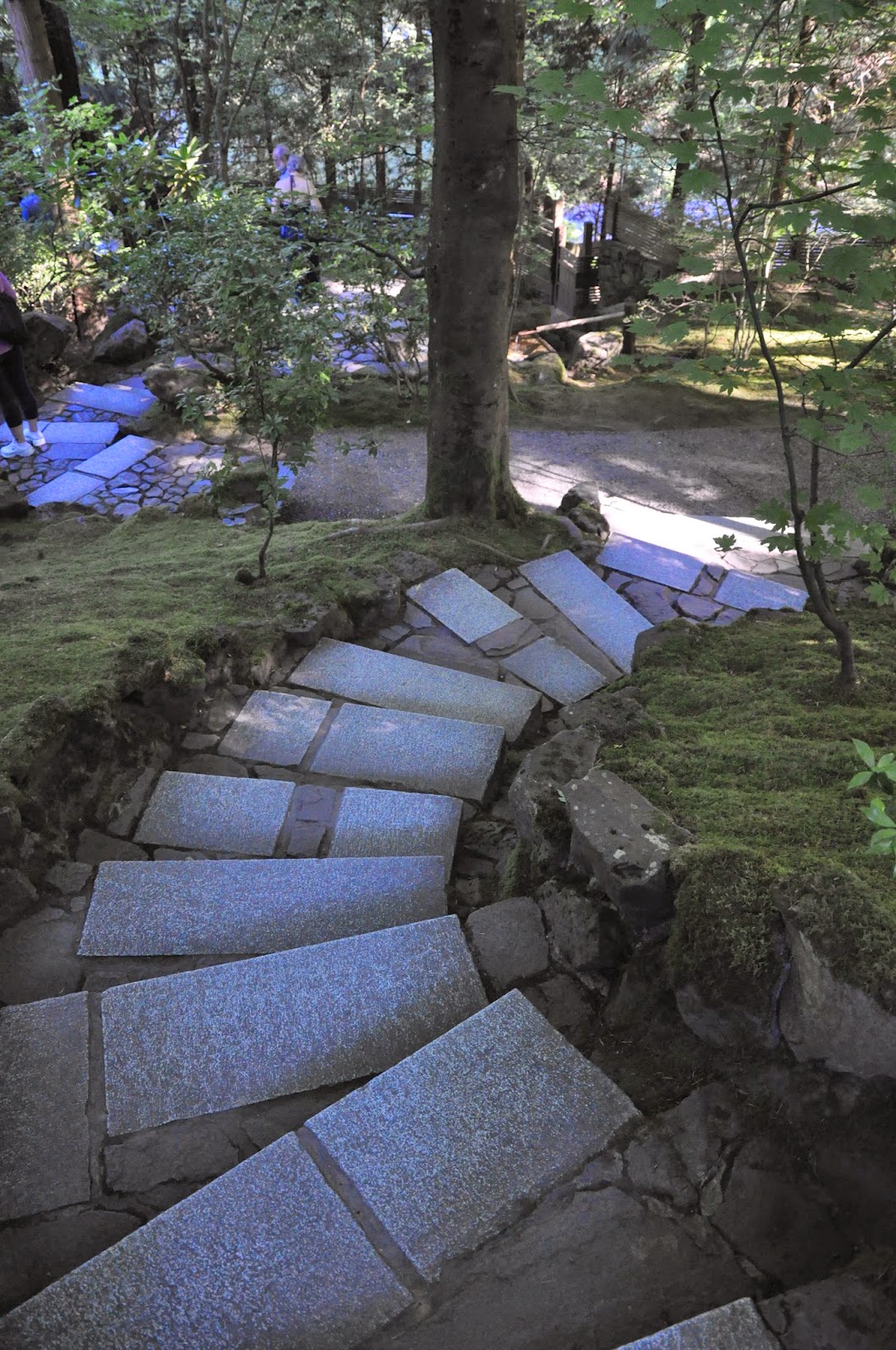
The Japanese Garden is divided into five distinctive areas, each representing a different type of garden. They reflect the cycles of nature- changes of season, landscape, water levels, and the growth of trees and plants, life and death. Americans notice the unique bridges, lanterns and water basins but the most important elements are the use of stone, gates, water and plants. The pathways are deliberate, created as transitional spaces between gardens, allowing one to prepare for each experience.
The tea garden is for peaceful reflection and a detachment from the busyness of everyday life. The strolling garden replicates the gardens of residences that were designed to display wealth and status. It includes moon and zig-zag bridges, a waterfall and a large koi pond. The dry landscape garden, in the Zen Monastery tradition, was designed for contemplation and embraces the Japanese tradition of using “borrowed scenery” with its views of Mt. Hood and downtown Portland. The garden is designed to offer something new with each season, embracing the cycles of life and death, and illustrating the beauty of change. No cell phones allowed.
Debby Yoder is a contributor to Social Shutter as well as a Sociology major at Georgia State University. She can be reached at debby.yoder@gmail.com.

































 Debby Yoder